
How to Renew Rent Agreement Online: Step-by-Step Guide
To renew a rent agreement online in India, both parties log into a digital agreement platform, update the rent and tenancy period, pay fresh stamp duty (renewal is a new instrument, even if terms are unchanged), e-sign, and download the e-stamped copy — typically completed in 24–48 hours.
Most Indian rental agreements run for 11 months, which means renewal isn't a one-time event — it's something nearly every landlord and tenant handles every year. Online renewal, using an approved platform such as GoodTenent is a way to avoid notary's visit, the printed stamp paper, and the scheduling delays that can make renewals offline slow.
This guide will walk you through the entire renewal procedure, the forms you require, the current stamp duty regulations and how renewal differs from simply an extension, and the best way to complete the entire process from the GoodTenent application.
Rent Agreement Renewal at a Glance
|
Topic |
Key Details |
|
What it is |
Executing a new term on an expiring or expired tenancy between the same landlord and tenant |
|
When to start |
30–45 days before the current agreement expires |
|
Renewal vs. extension |
Renewal = a fresh agreement with renegotiated terms; extension = the same terms, just a longer end date |
|
Stamp duty |
Payable again on renewal, even if rent and terms are unchanged — it's treated as a new instrument |
|
Documents needed |
Previous agreement, ID proof, ownership proof (landlord), updated rent details, photographs |
|
Online timeline |
24–48 hours, depending on verification |
Related: Why Rent Agreement Is For 11 Months in India
What Is Rent Agreement Renewal
Renewal means executing a new term on a tenancy after the existing agreement's period ends. Since most Indian residential agreements are set at 11 months specifically to avoid mandatory registration under the Registration Act, renewal is a recurring, expected step rather than an exception — landlords and tenants in cities like Delhi, Mumbai, Bengaluru, and Jaipur typically go through it annually.
Every renewal is a new legal document. It has the same force as the initial agreement and both parties are able to make use of it to alter the rent or deposit terms, maintenance conditions as well as the length of the following tenancy.
Renewal Vs. Extension: What's the Difference?
Both terms are commonly used interchangeably, but they're not identical, and their distinctions affect your stamp duty paperwork:
- Renewal creates a new agreement. The previous contract expires with the possibility of terms being completely changed (rent deposit clauses) and a new stamp duty will be due.
- Extension simply brings the end date of the current agreement forward by adding an addendum, while keeping the original terms. It's faster to execute but offers less room to update rent or conditions.
Most landlords in India opt for renewal rather than extension, because it allows an annual rent revision (commonly 5–10%) in line with the market. If you only need to push the end date without changing anything else, ask your platform for an extension addendum instead of a full renewal — it's a shorter document and often cheaper to stamp.
Why Timely Renewal Matters
An agreement that is not renewed leaves the tenancy unofficial and there is no legally binding document to refer to when a dispute arises regarding the rent, deposit return or a notice. The renewal prior to expiry (not following) makes the tenancy permanently recorded, which is important should either party require evidence of address or income for an employer, bank, and visa applications.
Documents Required to Renew a Rent Agreement
- Previous copy of the rent agreement
- Aadhaar or another government ID for both parties
- Property ownership proof (landlord)
- Updated rent and deposit figures for the new term
- Passport-size photographs of both parties
An app that allows online renewal usually adds a second procedure: OTP or digital-signature verification to verify both parties prior to the renewal document is signed.
Rent Agreement Renewal Notice Period
There's no single national rule, but in practice:
- Give written notice 30–45 days before the current agreement's expiry — this is the window most landlords and platforms build renewal workflows around.
- Some housing societies and commercial leases require 60 days, so check your existing agreement's termination clause first — it usually states the exact notice period both sides agreed to.
- If neither party gives notice and the tenant simply continues staying and paying rent, the tenancy can be treated as a "holding over" arrangement under Indian law, which is legally murkier and worth avoiding by renewing on time.
Rent Agreement Renewal Format
A renewal document follows the same structure as the original agreement, updated with new terms:
- Agreement title and date
- Landlord and tenant details
- Property address
- New rent amount and tenancy period
- Deposit, maintenance, and notice-period terms
- Signatures and witness details
If you only need to extend the timeline without changing anything else, use an extension addendum instead — it references the original agreement and changes only the end date, rather than replacing the whole document.
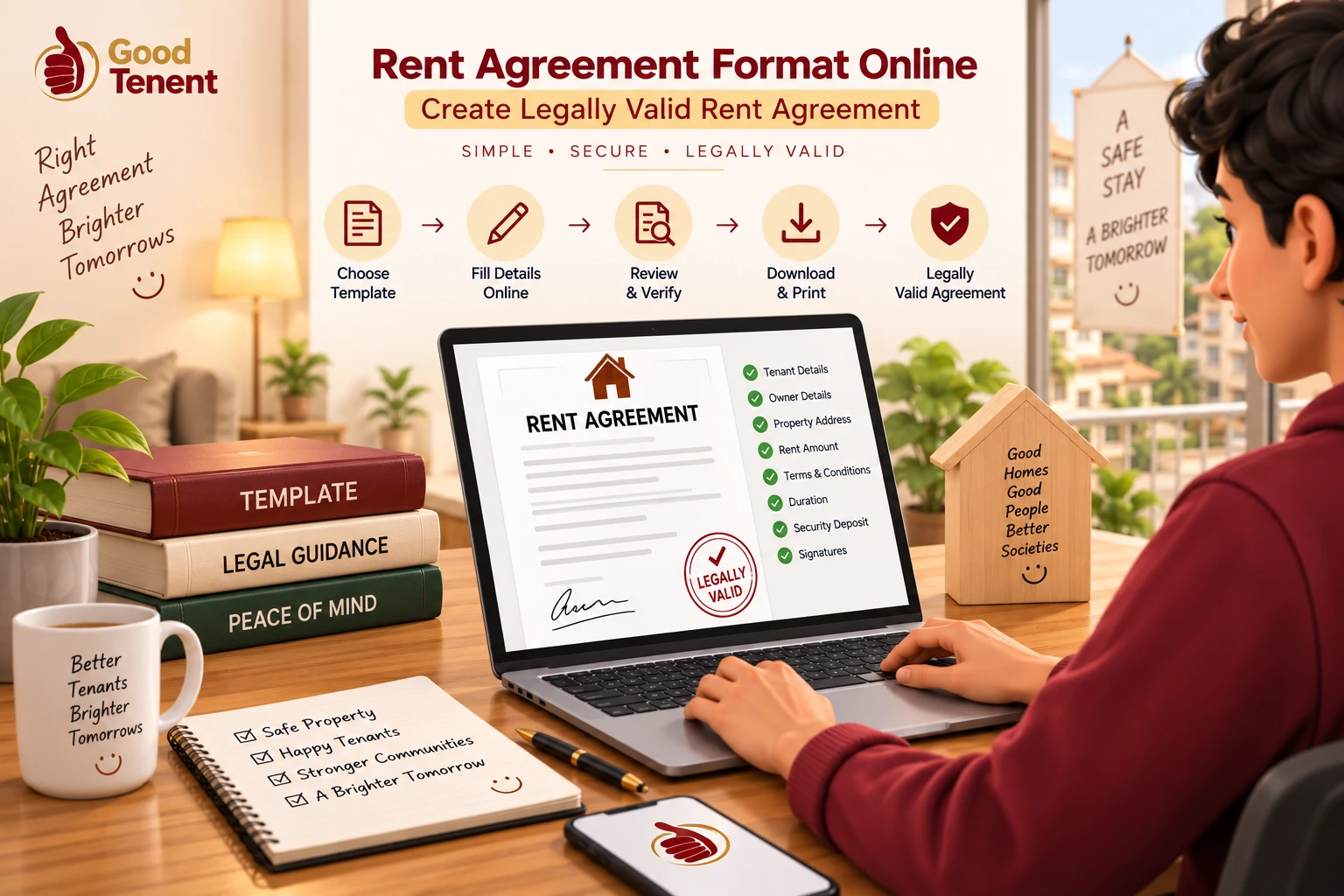
Related: Rent Agreement Format Online
Steps to Renew a Rent Agreement Online
- Go to a verified digital agreement platform.
- Upload your previous agreement and confirm tenant/landlord details.
- Enter the new rent amount and tenancy period.
- Select the stamp paper value based on your state and the new rent.
- Pay the applicable stamp duty and service charges.
- Review the draft, e-sign, and download the e-stamped renewed agreement.
Most platforms complete this in 24–48 hours, depending on how quickly both parties verify and sign.
Renew Your Rent Agreement Online with the GoodTenent App
- Log in to the GoodTenent app with your registered mobile number or email.
- Open "My Agreements" from the dashboard.
- Choose the agreement you would like for renewal from current lease.
- Click "Renew Agreement" to start the process.
- Update the amount of rent, deposit or the tenancy duration in the event that anything changes.
- Review the new terms before proceeding.
- E-sign — both landlord and tenant sign digitally within the app.
- Pay stamp duty and service charges securely through the app, if applicable.
- Download your renewed agreement as a PDF for your records.
- Both parties get an instant notification once renewal is complete.
Prefer to start from scratch instead of renewing an old document? You can also create a new digital rental agreement directly through GoodTenent.
Rent Agreement Renewal Charges and Stamp Duty
This is the part most people get wrong: renewal is a new instrument, so stamp duty applies again — even if the rent and terms haven't changed. Charges typically include:
- Stamp duty, usually 0.25–0.5% of the annual rent value, varying by state
- Registration or notary charges, only if you're renewing offline through a registrar or notary
- Online processing fees, generally ₹200–₹1,000 depending on the platform
Stamp duty rules differ meaningfully by state — Maharashtra, for instance, allows stamp duty payment through its GRAS portal for both fresh and renewed agreements, while other states route renewal stamping through local sub-registrar offices or authorised e-stamp vendors. Always confirm your state's current rate before paying.
Related: Stamp Duty on Rent Agreement in India: State-Wise Rules
Legal Validity of a Renewed Rent Agreement
A renewed agreement is fully valid and enforceable under Indian law once it's e-stamped and signed by both parties, the same as any original agreement. Renewals that are processed via verified platforms are subject to the stamp duty regulations and, in the event that the term is more than 12 months, registration requirements are governed by the Registration Act, 1908.
- Forgetting to update the rent escalation clause
- Letting the agreement lapse before starting renewal
- Missing signatures or witness details
- Not keeping a digital copy of the signed, e-stamped document
- Assuming stamp duty isn't needed again because "nothing changed"
FAQs About Rent Agreement Renewal
Q1. Can I renew my rent agreement after it has already expired?
Yes, but it's best to renew before expiry — a lapsed agreement leaves the tenancy undocumented in the interim, which can complicate disputes over rent or deposit.
Q2. Are online rent agreement renewals legal in India?
Yes, as long as they're e-stamped and digitally signed through a certified platform like GoodTenent.
Q3. Do I need to pay stamp duty again if I'm renewing with the same terms?
Yes. Renewal creates a new legal instrument, so stamp duty applies again regardless of whether the rent or terms have changed.
Q4. What's the difference between renewing and extending a rent agreement?
Renewal replaces the agreement with a new one and allows full renegotiation of terms. Extension keeps the existing agreement intact and only pushes the end date forward.
Q5. How many times can a rent agreement be renewed?
There's no legal limit — most 11-month agreements in India are renewed annually for as long as both parties want to continue the tenancy.
Q6. Who pays the rent agreement renewal charges?
This is negotiable between landlord and tenant, though tenants conventionally cover it in most markets.
Q7. Can rent or deposit be changed during renewal?
Yes — both parties can revise rent, deposit, and other terms as part of the renewal, which is one of the main reasons landlords prefer renewal over a simple extension.
Q8. Do commercial leases follow a different renewal format?
Yes, commercial renewals typically include additional clauses covering business use, GST, and longer notice periods than residential agreements.
Final Thoughts
Renewing your rent agreement on time protects both parties legally and keeps the tenancy on record without gaps. Platforms like GoodTenent turn what used to be a notary-office errand into a same-day digital process — upload, update, e-sign, and you're done.