Paying Guest Agreement Format: Free Template & Complete Guide for India
A paying guest agreement format is a written licence document between a property owner and a paying guest that records the room/bed allotted, rent and deposit terms, house rules, and notice period — while clearly stating that the paying guest has no tenancy rights over the property. Unlike a standard rent agreement, it doesn't create a landlord-tenant relationship, which is why using a regular lease format for a PG arrangement can leave owners legally exposed. Below is a ready-to-use format, the clauses it must include, and how to make it legally valid in India.
What Is a Paying Guest Agreement?
A paying guest (PG) arrangement is a written agreement between the property owner and guests who pay to set out the rules of staying in a common and/or single room on a rental basis, typically including meals and utilities. Contrary to standard rent agreements that create an underlying landlord-tenant relationship, it's a licence and not a lease; that's why the clauses are different.
Paying Guest Agreement vs. Rent Agreement: What's the Difference
Landlords typically use a typical house rent agreement template to create a PG agreement, which can create legal risk. A PG agreement must clearly state that the guest paying for the service is licensed and not a tenant and has no right to claim tenancy rights, sublet, or take possession -rights an ordinary tenant would be entitled to. The agreement should also include shared space rules (kitchen, bathrooms, kitchen common spaces) and meal/utility provisions, curfews or visitor policies and the occupant limit for each room, none of which are included in a home or flat contract. For a full breakdown of the standard rent agreement format for other property types, see our rent agreement format guide.
Essential Clauses in a Paying Guest Agreement Format
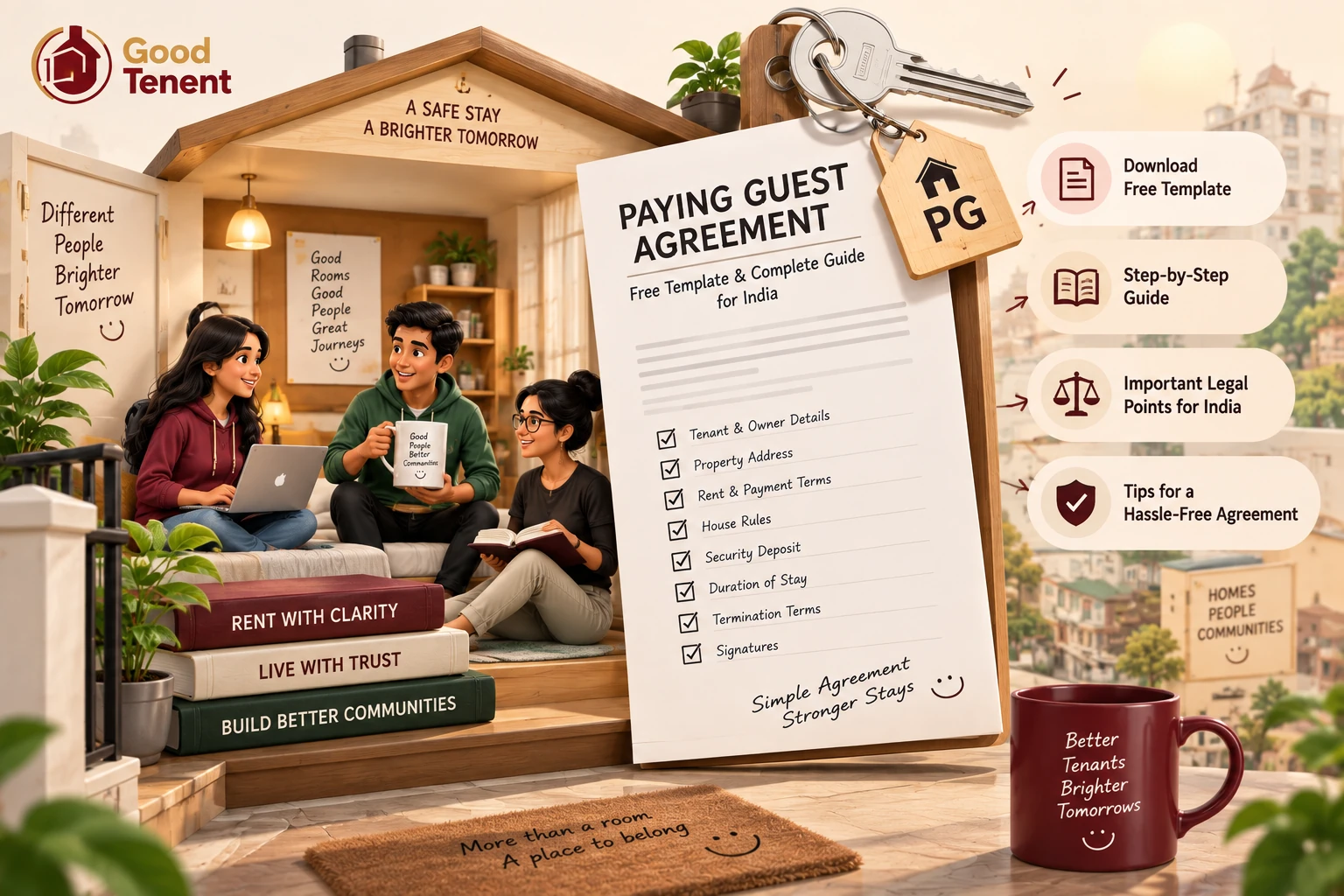
A legally sound PG agreement format should include:
- Parties and property details — full name, ID, and address of the owner and the paying guest, along with the exact room/bed being allotted
- Nature of occupancy -- an explicit licence clause that states the guest who pays rent is not entitled to a tenancy that they cannot sublet and cannot assert possession
- Terms of rent and payment (monthly/quarterly fees, due date, method for payment and what the amount comprises (electricity, Wi-Fi, water, meals)
- Security deposit amount, conditions for refund and deductions for damages
- Duration and the notice period: beginning date, duration of stay, and notice period to be vacated (commonly for 30 days)
- House rules - curfew times, visitor policies and restrictions (smoking or drinking and loud)
- Termination clause — grounds on which either party can end the arrangement early
Signatures — both parties, ideally with a witness
Sample Paying Guest Agreement Format (Structure)
PAYING GUEST AGREEMENT
This agreement is made on [date] between [Owner Name], residing at
[Owner Address] (hereinafter "Owner"), and [PG Name], holder of
[ID Type & Number] (hereinafter "Paying Guest").
1. The Owner agrees to permit the Paying Guest to occupy [Room/Bed
details] at [Property Address] on a paying guest basis only.
2. This arrangement shall commence from [start date] for a minimum
period of [duration].
3. The Paying Guest shall pay Rs. [amount] per [month/quarter],
inclusive of [utilities/meals, if any], payable by the [date] of
each period.
4. A security deposit of Rs. [amount] shall be paid, refundable on
vacating, subject to deductions for damage or dues.
5. The Paying Guest shall have no right to claim tenancy, sub-tenancy,
or possession of the premises, and shall not sub-let the room.
6. [House rules — curfew, visitors, restrictions]
7. Either party may terminate this agreement with [30] days' written
notice.
Signed: _______________ (Owner) _______________ (Paying Guest)
Witness: _______________
This structure works as both a paying guest agreement format in Word (editable) and a paying guest agreement format PDF (for signing/sharing) — you can create and download either version instantly through GoodTenent's digital rental agreement service.
Is Notarization or Stamp Paper Required for a PG Agreement?
Since a PG agreement is a licence and not a lease, it typically doesn't require the same registration treatment as an 11-month rent agreement, but notarizing it on stamp paper is still recommended — it gives both parties a legally recognisable document in case of a dispute, and many societies/PG associations ask for it before allotting a room. Requirements vary by state; see our stamp duty state-wise guide for specifics, and our security deposit rules guide for deposit-specific clauses.
Should You Verify a Paying Guest Before Signing?
A signed agreement protects you on paper, but it doesn't confirm who you're actually letting into your property. PG owners face the same identity, background, and police-verification exposure as any landlord — arguably more, since PG stays turn over faster and involve less documentation scrutiny than standard rentals. Before finalising the agreement, run an identity and background check through GoodTenent's tenant verification service; it also covers PG-specific occupancy rules in our PG & society rental rules guide.
Common Mistakes in PG Agreements
- Using a standard rent agreement format instead of a PG-specific one
- Leaving out the "no tenancy rights" licence clause (the single most important protection for the owner)
- Not specifying what's included in the fee (meals, Wi-Fi, laundry)
- Skipping ID/background verification because the stay feels informal
- No written notice-period clause, leading to disputes at exit
FAQs
Q1. Is a paying guest agreement legally valid in India?
Yes. While it isn't governed by the same Rent Control Act provisions as a lease, a written and signed PG agreement — ideally on stamp paper — is legally valid and enforceable as a contract.
Q2. Is registration mandatory for a PG agreement?
No, registration under the Registration Act typically isn't mandatory for PG/licence arrangements the way it is for 11-month+ leases, but notarization is still advisable for legal standing.
Q3. What's the difference between a rent agreement and a paying guest agreement?
A rent agreement creates a landlord-tenant relationship with tenancy rights; a PG agreement is a licence for shared accommodation where the occupant has no tenancy or possession rights.
Q4. What documents are required to sign a PG agreement?
ID proof (Aadhaar/PAN/Passport) and address proof of both parties, a passport-size photo of the paying guest, and property ownership proof of the owner.
Q5. Can I get a paying guest agreement format in Word or PDF for free?
Yes — you can create, customise, and download a PG agreement in Word or PDF format free through GoodTenent's digital rental agreement tool.