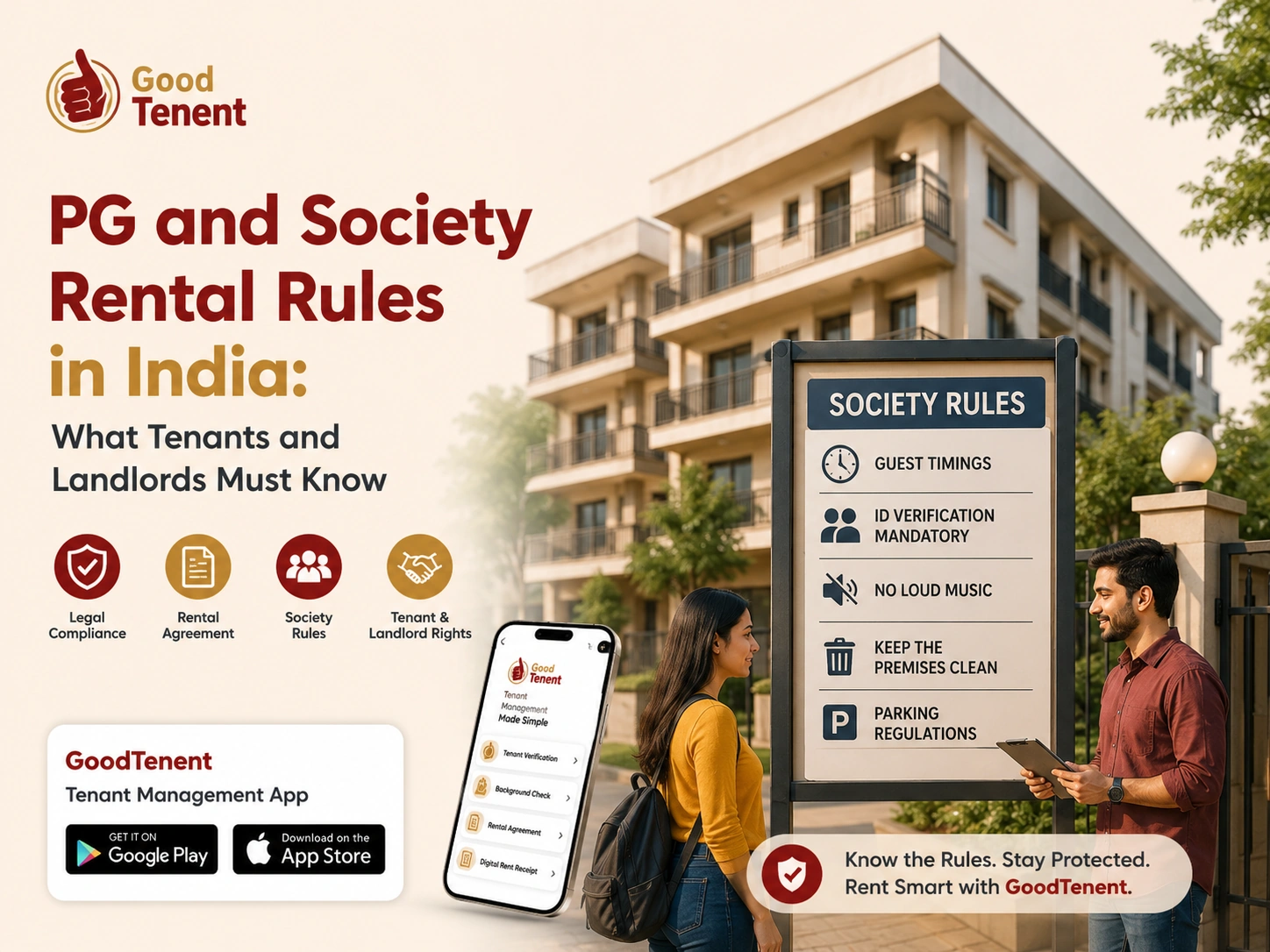
PG and Society Rental Rules in India: What Tenants and Landlords Must Know
Search "PG rules in India" and you'll get articles about paying guest agreements. Search "housing society rules" and you'll get articles about RWAs, maintenance, and parking. What almost nobody covers is the point where the two collide — a PG or rented flat sitting inside a housing society, where the tenant has to answer to both a landlord and a Resident Welfare Association (RWA) that didn't sign the rent agreement but still controls the gate, the lift, and half the "rules" that get enforced on move-in day.
That overlap is where most disputes actually happen. A tenant gets denied entry after 10 PM by security. A landlord is told by the RWA they "can't rent to bachelors." A PG operator gets a notice for running a "commercial establishment" in a residential society. None of these are covered by a standard rental agreement — they sit in the grey zone between tenancy law and society bylaws.
This guide covers both layers together: what the Model Tenancy Act, 2021 and state tenancy laws say tenants and landlords owe each other, and what a housing society or RWA can — and legally cannot — impose on top of that.
If you're a landlord trying to avoid exactly this kind of dispute before it starts, GoodTenent's Tenant Verification service and Due Diligence checks are built to catch red flags before move-in, not after.
Two Different Rulebooks, One Rental
Before anything else, it's worth being precise about who governs what — because most disputes stem from people assuming the wrong authority has the final word.
| Governs | Legal Basis | Can Decide | Cannot Decide |
|---|---|---|---|
| Landlord–Tenant relationship | Rent agreement + Model Tenancy Act / state Rent Act | Rent, deposit, notice period, maintenance responsibility, entry rights, eviction grounds | Who is "allowed" to live in the society based on marital status, religion, profession |
| RWA / Housing Society | Society bylaws under state Cooperative Societies Act / Apartment Ownership Act | Common-area use, visitor/security protocols, noise and parking rules, maintenance charges on the unit | Rent amount, tenancy duration, eviction, or who a landlord is allowed to rent to |
The single most important thing to understand from this table: an RWA is not a party to your rental agreement. It cannot dictate tenancy terms. It can only regulate how residents — owners and tenants alike — use shared spaces and follow security protocol. Anything beyond that is typically an overreach, even if it's commonly enforced anyway. This principle was reinforced at the highest level — see our coverage of the Supreme Court ruling that a tenant cannot dictate how a landlord uses their property, which cuts both ways: third parties, including RWAs, don't get to override a landlord's ownership rights either.
For the fundamentals on where tenant and landlord rights begin and end more broadly, see our companion guides on tenant rights in India and landlord rights in India.
What the Model Tenancy Act Actually Covers (and What It Doesn't)
The Model Tenancy Act, 2021 is a central framework several states have adopted in some form, designed to standardize landlord-tenant relations. We've covered the Act in full detail here — the provisions most relevant to PG and society-based rentals are:
- Security deposit caps. The Act requires a landlord and tenant to sign a written agreement specifying rent and tenancy terms, and it caps the security deposit at two months' rent for residential premises. <cite index="58-1">Security deposit is capped at two months' rent for residential premises, and six months' rent for non-residential premises.</cite> Some states' draft rules cap PG deposits differently — always check your state's notified version rather than assuming the central Act applies verbatim. For the mechanics of how a deposit should be documented, see security deposit clauses in a rent agreement.
- Entry and privacy rights. Once a tenancy begins, a landlord cannot enter the property without prior notice — most versions of the Act require at least 24 hours' notice before a visit. <cite index="60-1">The landlord cannot enter the house rented to the tenant without informing them in advance twenty-four hours before such a visit.</cite> This applies to PG landlords too, even when the landlord lives on the same premises.
- Eviction grounds are defined, not open-ended. A tenant generally can't be evicted arbitrarily — valid grounds include non-payment of rent, unauthorized subletting, or misuse of the premises after written notice. <cite index="60-1">No landlord shall withhold any essential supply or service in the premises occupied by the tenant.</cite>
- Dispute resolution is meant to bypass civil court. The Act establishes a three-tier mechanism — Rent Authority, Rent Court, and Rent Tribunal — specifically so landlord-tenant disputes don't have to go through slow civil litigation. <cite index="58-1">The Model Act establishes a three-tier quasi-judicial dispute adjudication mechanism consisting of a Rent Authority, Rent Court, and Rent Tribunal.</cite>
What it doesn't cover: society-level rules, PG licensing with municipal authorities, or zoning approval for running a PG as a commercial operation. Those sit outside tenancy law entirely — which is exactly why disputes involving PGs inside residential societies get complicated fast.
PG-Specific Rules: What Makes a PG Legal
Unlike standard tenancies, there's no single central law defining what a PG is. <cite index="48-1">There is no central legislation that specifically defines a paying guest accommodation.</cite> Whether a PG can legally operate in a residential building depends on local municipal and zoning rules — and this is where a growing number of PGs are getting into trouble.
Municipal and Zoning Compliance
Cities have started actively enforcing zoning norms against PGs and guest houses operating out of purely residential plots without commercial approval. A recent enforcement drive in Gurugram illustrates the risk clearly: authorities sealed several residential properties that had been converted into PGs, guest houses, and other commercial uses without the required approvals, citing the strain this placed on water, sewage, and electricity infrastructure meant for residential use only. <cite index="48-1">Several residential plots had been converted into commercial establishments, including PGs, guest houses, clinics, gyms and beauty parlours, resulting in excessive pressure on water, sewage and electricity infrastructure.</cite>
Crucially, when an unauthorized PG gets sealed, it's rarely the property owner who deals with the immediate fallout. <cite index="48-1">When an unauthorised PG is sealed, it is the residents who frequently bear the immediate consequences.</cite> If you're a PG tenant, checking that the property has proper municipal approval is just as important as reading the rent agreement — because your landlord's non-compliance becomes your problem on move-out notice.
On the tax side, PG and student hostel rentals recently got clarity from the top court — see our coverage of the Supreme Court ruling that no GST applies to student hostel and PG rentals, which is directly relevant if you're comparing costs across PG operators.
Police Verification — Mandatory in Practice, Not Just in Theory
Police verification of PG occupants is recommended nationally and actively enforced as mandatory in several metro cities. <cite index="54-1">Police verification is recommended and in most metro cities mandatory for PG accommodation, with cities like Delhi and Bengaluru actively enforcing verification requirements for PG operators.</cite> For girls' PG hostels in some cities, police may go a step further and inspect safety arrangements before issuing the verification certificate.
Housing societies and RWAs are increasingly asking for this documentation independently of what the PG operator provides — largely to protect the wider resident community. <cite index="54-1">Housing societies and RWAs are asking for this kind of verification more often these days, in order to guard the wider residential community.</cite>
For landlords: completed police verification isn't just a compliance checkbox — it's your legal cover. Landlords who complete tenant verification are generally in a stronger legal position if any criminal activity occurs on the premises. <cite index="54-1">If landlords do tenant verification, they're usually shielded legally, should any criminal activity happen on the premises.</cite> We've broken down the full process separately in police verification for tenants in India: process, documents, and timeline, and the underlying case for why it matters at all in why tenant police verification and background checks are essential.
This is precisely the gap GoodTenent's Tenant Verification service is built to close — identity, address, and background checks completed before a tenant moves in, not scrambled together after a society raises a flag.
PG Licensing Before You List
Before converting any space into a PG, owners are expected to secure the necessary local and state approvals, and this is a legal — not optional — obligation for anyone monetizing the space. <cite index="62-1">Before you make a profit out of the PG accommodations, as a responsible taxpayer, it is your duty and legal obligation to take necessary approvals and licenses from the concerned local and state authorities.</cite> Landlords should also insist on a written and, where the term exceeds 11 months, registered rent agreement — an oral arrangement offers neither party real protection. <cite index="62-1">It is better to have a written agreement in any eventuality between a lessor and a lessee which discusses all their rights and duties and also safeguards the interests of both, tenant and landlord.</cite> For what such an agreement should actually contain, see documents required for a rent agreement.
What an RWA / Housing Society Can Legally Do
Once you're past the PG-specific rules, the second layer is the society itself. RWAs derive their authority from bylaws registered under state cooperative or apartment ownership laws — not from your tenancy agreement. Within that authority, they can legitimately:
- Set rules for noise levels, parking allocation, and use of common areas like gyms, halls, or gardens
- Require visitor registration and security protocols, including digital gate-pass systems
- Mandate waste segregation and cleanliness standards
- Require tenant details to be shared with the society office (often alongside, not instead of, police verification)
- Levy maintenance charges tied to the unit — though who actually pays (owner or tenant) is a matter for the rent agreement, not the RWA to dictate
- Require renovation approvals before structural changes are made to a unit
<cite index="47-1">Common housing society rules cover maintenance payments, parking allocation, waste segregation, noise control, visitor management, tenant verification, renovation approvals, and use of common areas.</cite> Generally, tenants are expected to follow the same conduct rules as owners on these fronts. <cite index="47-1">Tenants are generally expected to follow the same community rules as owners, including noise regulations, parking rules, waste disposal guidelines, and common area usage policies.</cite>
Importantly, society rules operate around the tenancy, not inside it. <cite index="50-1">Society rules ensure maintenance of decorum, safety, and living standards through guidelines on noise levels, use of common areas, and parking norms, and do not interfere in rental negotiations or specific terms of tenant-landlord agreements.</cite> For a deeper look at where the line sits between the two, our combined tenant-landlord rights in India guide is a useful companion read.
What an RWA Cannot Legally Do (Even If It's Common Practice)
This is the section most tenants and even landlords get wrong — because "the society said no" often gets treated as final, when it legally isn't.
An RWA cannot ban tenants based on categories like marital status, religion, gender, or profession, and it cannot restrict a landlord's right to rent out their own property. <cite index="52-1">RWAs cannot ban certain categories of tenants, prevent landlords from renting their property, or dictate who can reside in the society, as this violates housing laws and constitutional rights.</cite> The common "no bachelors" or "no PG tenants" rule that many societies enforce informally has no binding legal basis — it's typically social pressure dressed up as policy, and it can be legally challenged.
An RWA also cannot:
- Charge tenants a different (usually higher) maintenance rate than owners without a documented, bylaw-based justification
- Restrict a tenant's access to common amenities that owners can use, unless the same restriction applies uniformly
- Enter a rented unit without the tenant's consent, just as a landlord cannot
- Use society funds for anything beyond resident welfare and maintenance — RWAs are barred from running the society as a profit-making enterprise <cite index="52-1">RWAs cannot engage in profit-making businesses; their funds must be used only for the welfare and maintenance of the society.</cite>
If a society is overstepping, the tenant's practical recourse usually runs through the landlord first (since the RWA has no direct legal relationship with the tenant), and escalates to the RWA's registering authority or, in serious cases, civil court if constitutional rights are involved. Our Legal Cell service supports both tenants and landlords navigating exactly this kind of overreach.
A Combined Compliance Checklist: PG + Society
Use this before signing anything — whether you're the tenant moving in or the landlord/PG operator onboarding someone.
For Tenants (before move-in):
- Confirm the PG/flat has valid municipal/zoning approval for its use (residential vs. PG/commercial)
- Get a written rent agreement — registered if the term exceeds 11 months
- Confirm the security deposit is within the legally reasonable range for your state
- Clarify entry/visit rights and hours in writing (commonly 7 AM–8 PM with 24 hours' notice)
- Ask specifically about kitchen access, guest policy, and curfew — these are rarely volunteered upfront
- Complete police verification through the landlord or PG operator — don't assume it's been done
For Landlords / PG Operators (before listing):
- Secure local body approval before operating a PG out of a residential unit
- Complete tenant identity, address, and background verification for every occupant
- Maintain a written, and where applicable registered, rent agreement for every tenant
- Share tenant details with the RWA/society office as required — this protects you as much as the society
- Set and document a clear visit/inspection policy consistent with Model Tenancy Act norms
- Keep security deposit within legal limits and return it promptly, net of documented deductions
For landlords managing multiple units or a full PG operation, GoodTenent's Due Diligence service verifies both tenant and property-side compliance in one process — worth reading alongside our post on how a tenant scorecard reduces landlord risk if you're managing more than one property.
Where Disputes Actually Come From — And How to Avoid Them
In practice, almost every PG-in-society dispute traces back to one of three gaps:
- No written agreement covering society-specific terms. Verbal promises about guest policy, curfew, or kitchen access don't hold up when a dispute reaches the RWA or a rent authority. Put it in writing, even in a PG.
- The RWA is treated as the final authority on tenancy questions it has no jurisdiction over. Landlords who cave to informal society pressure ("no PG tenants allowed") often do so because they don't know the RWA has no legal standing to enforce that — see the section above.
- Verification happens reactively, after a complaint, instead of proactively, before move-in. This is the single most preventable gap. A completed police verification and background check resolves most society objections before they're raised, because the documentation already exists.
That third point is exactly the problem GoodTenent was built to solve — verified tenant profiles, documented rental history, and completed background checks that a landlord can show a society (or a rent authority) on day one, instead of scrambling to produce them after a dispute starts.
Whether you're a landlord tired of society pushback or a PG tenant who wants documented proof of a legitimate, compliant stay, start with verification — not after a complaint, but before one. Explore Tenant Verification or see how GoodTenent helps landlords build a track record with Great Landlords.
Frequently Asked Questions
Can a housing society (RWA) stop a landlord from renting to a PG tenant?
No. An RWA has no legal authority over who a landlord rents to. It can regulate common-area use and security protocols, but it cannot dictate tenancy decisions, and blanket bans on PG tenants or bachelors are not legally enforceable, even though they're commonly attempted.
Is police verification mandatory for PG tenants in India?
It's mandatory in practice in most metro cities, actively enforced in places like Delhi and Bengaluru, and is reinforced by the Model Tenancy Act as a foundational step before finalizing any rental arrangement. Requirements vary by state, so check local rules.
What is the maximum security deposit a PG or landlord can charge?
Under the Model Tenancy Act framework, residential security deposits are generally capped at two months' rent, though some states apply different limits, particularly for PG accommodation — always verify your state's specific notified rules.
Can an RWA charge tenants higher maintenance than owners?
Not without a documented, bylaw-based justification. Differential charging without basis in the registered society bylaws is generally not defensible if challenged.
What makes a PG illegal in India?
There's no single national PG law — legality depends on local municipal and zoning approval. A PG operating in a purely residential building without commercial-use permission, or exceeding permitted density, risks enforcement action, as seen in recent city-level crackdowns.
Can a landlord or RWA enter a rented room without notice?
No. Under the Model Tenancy Act framework, entry typically requires prior notice — often 24 hours — except in genuine emergencies. This applies to PG landlords living on the same premises as much as it does to any other landlord.